
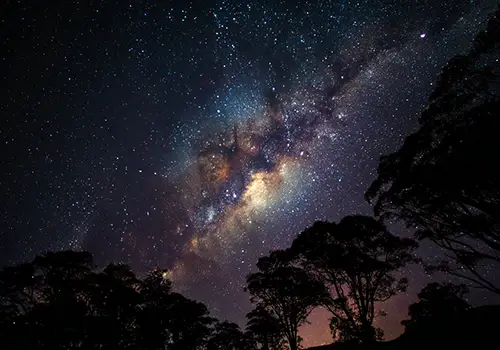
You know that moment when city people first see proper stars? That jaw-drop, “wow!” moment when they realise the night sky isn’t supposed to be orange? That happens a lot at the tourist park. The Otways is one of those places where you can still see the Milky Way stretching across the sky like someone spilled paint up there.
We’re lucky here. Melbourne’s far enough away that its light pollution doesn’t wreck the sky, and the nearest big towns are Colac and Geelong, both an hour away. Apollo Bay puts out a bit of light but nothing compared to the city. On a clear moonless night, you can see stars you didn’t even know existed. Makes you feel pretty small, in a good way.
The Southern Cross is the obvious one. Every Aussie knows it from the flag but seeing it properly in a dark sky is different. It’s bright, really bright, and Pointers (Alpha and Beta Centauri) line up perfectly to show you where it is. Once you’ve found it, you can’t unsee it.
The Milky Way is the showstopper though. In winter it arcs right across the sky from horizon to horizon. That cloudy band is actually billions of stars so far away they blur together. The galactic centre rises in the east after dark in winter – that’s the brightest, densest part. Looks like storm clouds made of stars.
Orion’s up there in summer, though he’s upside down compared to how Northern Hemisphere folks see him. The saucepan (Orion’s belt and sword) is easy to spot. That fuzzy bit in the sword? That’s the Orion Nebula – a massive star factory. With binoculars you can actually see it’s not just a star but this glowing cloud.
The Magellanic Clouds are special down here. They look like little chunks of the Milky Way that got lost. They’re actually whole other galaxies, only visible from the Southern Hemisphere. On a good night they’re obvious, just floating there like cosmic cotton balls.
Right from your cabin or tent site is honestly pretty good. The park keeps lighting minimal on purpose. Those orange lights you see are designed to reduce light pollution. Just walk away from the amenities block and let your eyes adjust for 20 minutes.
The beach at Wye River is brilliant for star gazing. You get this completely dark horizon over the ocean. Lying on the sand looking up is pretty special. Just remember it gets cold on the beach at night, even in summer. Bring a blanket or three.
If you want to get serious, head up to Benwerrin or Mount Cowley. The drive up takes about 30 minutes but you’re above any coastal haze and even the tiny bit of light from Apollo Bay. It’s properly dark up there. Scary dark if you’re not used to it. But the stars… mate, it’s like someone turned the brightness up to eleven.
The paddocks around Gellibrand are surprisingly good too. It’s inland so no coastal cloud, and it’s just farmland so no lights except the odd farmhouse. Pull over on a quiet road, turn the car lights off, and boom – universe in your face.
Winter (June to August) is actually the best time, which surprises people. The nights are longer, the Milky Way is in prime position, and the air is often clearer after cold fronts blow through. Yeah, it’s freezing!
New moon periods are obviously ideal – that two-week window when the moon is either not up or just a skinny crescent. Check a moon phase app before planning your stargazing night. Full moon kills star viewing but it’s pretty spectacular in its own right, especially rising over the ocean.
After a cold front is perfect. The rain clears all the crap out of the air and if the clouds bugger off, you get crystal clear skies. Some of the best viewing I’ve had has been the night after a massive storm.
Around 2am is peak viewing time if you’re hardcore. Most people are asleep, any remaining lights are off, and your eyes are fully adjusted. But honestly, any time from about an hour after sunset works fine.
You don’t need a telescope. Seriously. Your eyes are enough for most stuff, and trying to use a telescope without knowing what you’re doing is frustrating.
Binoculars are brilliant. You can see Jupiter’s moons, craters on our moon, star clusters, nebulae. The Pleiades (Seven Sisters) through binoculars is mind-blowing – goes from a fuzzy patch to dozens of bright blue stars.
Get a star map app on your phone. Stellarium, Sky Guide, Star Walk – they’re all good. Point your phone at the sky and it tells you what you’re looking at. Just turn the screen brightness right down or you’ll kill your night vision.
Red torch. Not white. Red light doesn’t stuff up your night vision. Wrap red cellophane around a normal torch if you haven’t got a proper one. Takes your eyes 20-30 minutes to fully adjust to darkness and one blast of white light ruins it.
Otways Tourist Park is nestled in Gellibrand, a short drive from the charming rural townships of Colac and Forrest, Victoria. Otways Tourist Park is a welcoming destination – perfect for those looking to unwind, slow down, and reconnect with nature and loved ones.
Nearby attractions include the world-famous Great Ocean Road, waterfalls, rainforest walks and the Otway Fly Tree Top Walk.
The park is also conveniently located within easy reach of popular destinations like Apollo Bay, Lorne and the Twelve Apostles, making it an ideal base for exploring the spectacular Otway Ranges and Surf Coast region.
